Why Precision Matters: The Life-Changing Benefits of Ultrasound-Guided Shoulder Injections
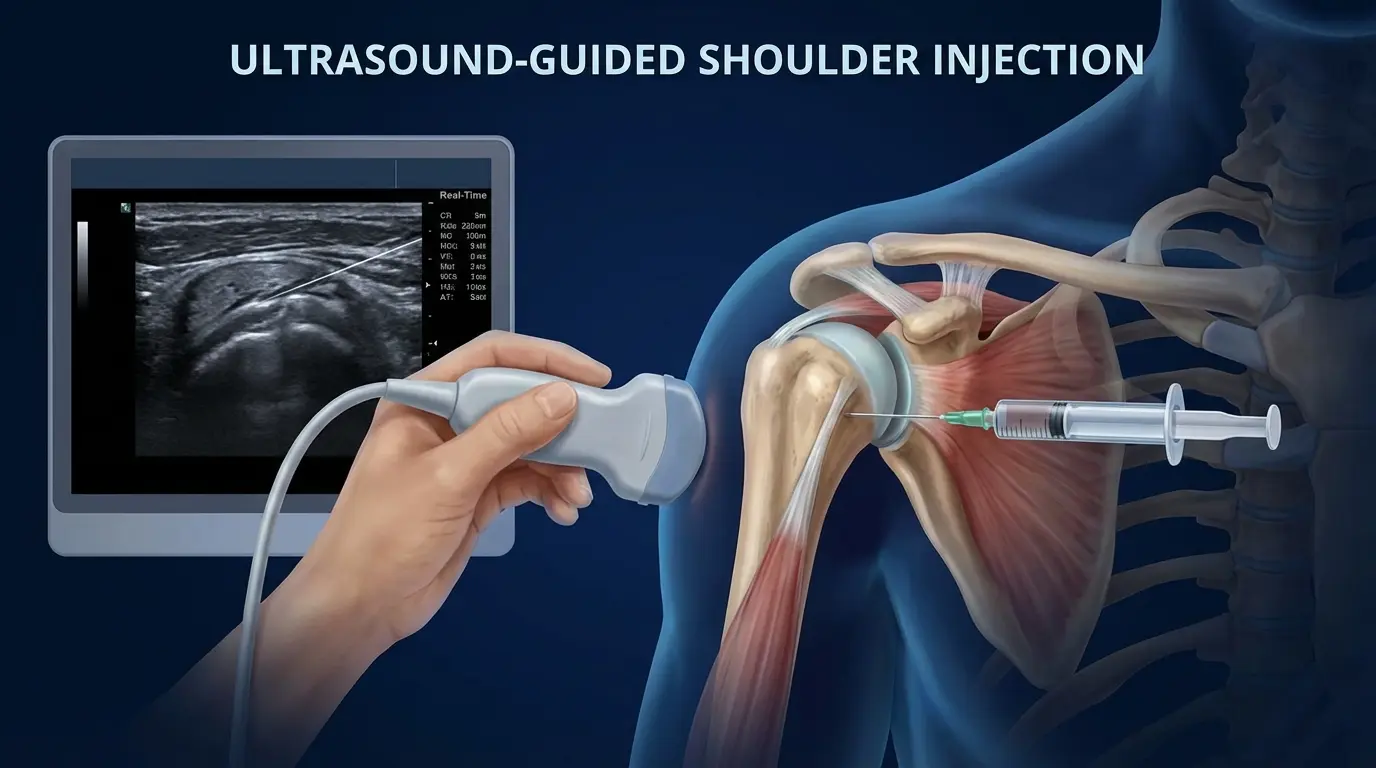
An ultrasound-guided shoulder injection uses live imaging to place the needle. Instead of estimating position from surface landmarks, the physician watches the needle tip on screen as it enters the bursa, joint space, or tendon being treated — placement is confirmed rather than assumed.
That distinction matters more in the shoulder than almost anywhere else. The subacromial bursa and the biceps tendon sheath are narrow spaces sitting close to structures you don’t want to inject, and an injection placed near the target instead of into it may do nothing at all.
Dr. Benjamin DuBois performs every shoulder injection under real-time ultrasound at his La Mesa practice. He has performed more than 10,000 ultrasound-guided injections and co-founded the MSK Ultrasound Course, where he has trained thousands of physicians in the technique.
This guide covers how guided injections differ from unguided ones, how ultrasound compares to X-ray guidance, and what that means for your treatment.
Are Ultrasound-Guided Shoulder Injections More Effective?
In most cases, yes.
Traditional “blind” injections rely on anatomical landmarks and physician estimation. Studies have found unguided shoulder injections miss the intended target in a meaningful percentage of cases, with rates varying by injection site.
Ultrasound guidance lets Dr. DuBois confirm placement rather than estimate it — he can see the needle tip enter the bursa, joint space, or tendon in real time.
Patients often experience:
- Faster pain relief
- Improved mobility and function
- More predictable treatment results
Why Traditional (“Blind”) Injections Fall Short
The shoulder is one of the most complex joints in the body, made up of tight spaces, delicate tendons, and critical nerves and blood vessels.
Without imaging, even a slight misplacement of the needle can result in medication being delivered outside the injured tissue. When this happens, patients may feel little to no improvement.
This is why many individuals who have received injections elsewhere report disappointing results—because the medication never reached the true source of their pain.
Ultrasound vs. X-ray guided shoulder injections
Both use imaging to place the needle, but they show the physician different things.
Fluoroscopy is live X-ray. It shows bone clearly and is often paired with contrast dye to confirm the needle has entered a joint space. It’s the long-standing approach for deep injections and remains standard for procedures where bony landmarks are what matter — spinal injections, for example. The tradeoffs are radiation exposure for both patient and staff, a dedicated suite rather than an exam room, and poor visualization of soft tissue.
Ultrasound shows soft tissue — tendons, bursa, muscle, nerves, blood vessels — which is what most shoulder injections are actually targeting. The rotator cuff tendons and the subacromial bursa are invisible on X-ray. There’s no radiation, it happens in the exam room during the same visit, and the physician can watch the needle move continuously rather than taking intermittent images.
For most shoulder injections, ultrasound is the more useful of the two, because the structures being treated are soft tissue. Fluoroscopy retains advantages where bone is the reference point or where a joint needs contrast confirmation in a deep, difficult-to-image patient.
How Shoulder Injection Guidance Methods Compare
| Feature | Unguided (“blind”) | Ultrasound-guided | X-ray (fluoroscopy) |
|---|---|---|---|
| What the physician sees | Nothing — position estimated from surface landmarks | Live image of tendons, bursa, joint, nerves and vessels | Live image of bone; soft tissue not visible |
| Radiation exposure | None | None | Yes — to patient and staff |
| Placement confirmation | None — position inferred from feel and anatomy | Direct visual confirmation before the injectate is delivered | Confirmed via bony landmarks, often with contrast dye |
| Real-time needle tracking | No | Yes — needle tip followed continuously | Intermittent images rather than continuous tracking |
| Cost | Lowest | Modest additional cost; guidance is separately billable | Highest — imaging suite, staff and contrast |
| Where it’s performed | Exam room | Exam room, same visit | Dedicated fluoroscopy suite |
For the soft-tissue structures most shoulder injections target — the rotator cuff tendons, the subacromial bursa — ultrasound is the practical choice, and it’s what Dr. DuBois uses for every injection he performs.
The DuBois Precision Approach
Dr. Benjamin DuBois is a board-certified, fellowship-trained orthopedic surgeon and a nationally recognized expert in musculoskeletal ultrasound. Through his work with OrthoSono, he has helped train thousands of physicians in advanced ultrasound-guided techniques.
At his practice, you benefit from a highly refined, precision-based approach:
Real-Time Visualization
Using live ultrasound imaging, Dr. DuBois guides the needle directly into the affected area. Patients can even watch the procedure as it happens, providing confidence that the treatment is accurately placed.
Improved Comfort
By visualizing surrounding nerves and blood vessels, the injection avoids sensitive structures—making the procedure more comfortable than traditional methods.
Better Results
When medication or biologic therapy is delivered exactly where it’s needed, patients often experience more meaningful and longer-lasting relief.
Why Precision Matters for PRP and Regenerative Treatments
Advanced treatments like PRP (Platelet-Rich Plasma) injections require even greater accuracy.
PRP uses growth factors from your own blood to stimulate healing in damaged tissues. But for PRP to work effectively, it must be placed directly into the injured tendon or joint.
With ultrasound-guided PRP injections, Dr. DuBois ensures the treatment is delivered precisely into areas such as rotator cuff tears or degenerative tendon tissue—maximizing the body’s natural healing response.
For patients exploring non-surgical options, precise placement is what makes the attempt worth making — and if it doesn’t get you where you need to be, Dr. DuBois can perform the repair himself.
Conditions Treated With Ultrasound-Guided Shoulder Injections
These precision-guided injections can help treat a wide range of shoulder conditions, including:
- Rotator cuff tears and tendinitis
- Shoulder impingement syndrome
- Bursitis
- Shoulder arthritis
- Frozen shoulder (adhesive capsulitis)
- Labral inflammation or irritation
By targeting the exact source of pain, these treatments can significantly improve comfort, mobility, and quality of life.
About Dr. Benjamin DuBois
Dr. Benjamin DuBois is a board-certified orthopedic surgeon specializing exclusively in shoulder care. With more than 20 years of experience and over 5,000 successful shoulder procedures, he combines advanced surgical expertise with cutting-edge non-surgical treatments.
His practice is built around:
- Accurate, in-office diagnosis using ultrasound
- Conservative treatment whenever possible
- Minimally invasive surgical options when needed
Learn more about his approach on the practice overview page.
Patients from across San Diego County trust Dr. DuBois for specialized, results-driven shoulder care.
Get the Right Treatment—Right Where It Matters
If you’ve tried treatments that didn’t work, the issue may not be the treatment itself—but where it was delivered.
Ultrasound-guided injections provide the precision needed to truly address the source of your pain.
Schedule a consultation with Dr. Benjamin DuBois today to learn whether ultrasound-guided therapy or PRP is right for your condition.
Frequently Asked Questions
How long does a shoulder injection take?
Most ultrasound-guided shoulder injections take less than two minutes from start to finish.
Can I drive after my appointment?
Yes. No sedation is used, so you can drive yourself home.
Is Dr. DuBois accepting new patients?
Yes. New patients are welcome at his La Mesa clinic, serving the greater San Diego area.
Are ultrasound-guided shoulder injections more accurate?
Yes. Ultrasound-guided injections are significantly more accurate than traditional “blind” injections because the physician can see the needle in real time as it enters the targeted tissue. This allows the medication or PRP to be delivered precisely into the joint, bursa, or tendon—improving effectiveness and reducing the risk of missing the injury.
Do blind shoulder injections work?
Blind shoulder injections can provide relief in some cases, but their effectiveness is less predictable. Because they rely on anatomical landmarks rather than imaging, studies have found unguided shoulder injections miss the intended target in a meaningful percentage of cases, with rates varying by injection site. This can lead to reduced pain relief or the need for repeat injections.
Is ultrasound necessary for PRP injections?
While PRP injections can technically be performed without imaging, ultrasound guidance is strongly recommended. PRP must be placed directly into the damaged tissue to stimulate healing. Without ultrasound, the injection may not reach the exact location of injury, which can reduce the effectiveness of the treatment.
Are ultrasound-guided injections more painful?
No—most patients actually find ultrasound-guided injections more comfortable. Because the physician can see and avoid sensitive structures like nerves and blood vessels, the procedure is typically smoother and less irritating than a blind injection.
Is ultrasound therapy the same as an ultrasound-guided injection?
No. They use the same technology for entirely different purposes.
Therapeutic ultrasound is a treatment modality, usually delivered by a physical therapist. A wand is moved over the skin to send sound waves into the tissue, generating deep heat with the goal of easing pain and stiffness. Nothing enters the body. It’s commonly used for frozen shoulder, though the research supporting it is limited — several controlled trials have found it adds little beyond the stretching and exercise it’s paired with.
Diagnostic and interventional ultrasound is imaging. The same sound waves produce a live picture of what’s happening inside the shoulder, letting a physician see the rotator cuff tendons, the bursa, and the joint itself. During an injection, that image shows the needle in real time as it reaches the intended structure. Nothing is being treated by the ultrasound — it’s how the physician sees where the needle is going.
The short version: therapeutic ultrasound is the treatment. Guidance ultrasound is how the treatment gets delivered accurately.
If you’ve had therapeutic ultrasound in physical therapy without much benefit, that says nothing about whether an ultrasound-guided injection would help you. They’re unrelated. Dr. DuBois uses ultrasound in the second sense — for diagnosis in the office and for guiding every injection he performs.
How long do the results of a shoulder injection last?
The duration of relief varies depending on the condition being treated and the type of injection used. Corticosteroid injections may provide relief for weeks to months, while PRP treatments aim to promote longer-term healing. Your doctor can help determine the best option based on your specific shoulder condition.