PRP From a Shoulder Surgeon vs. a Med Spa: What’s the Difference?
The short answer
Drawing blood and injecting it is the easy part. What determines whether a shoulder PRP injection helps you is everything around it: who diagnoses the problem, whether someone reads your MRI images rather than the report, whether the needle is guided in real time, and whether the practice can offer you something else when PRP is not the right answer.
PRP is now offered in a lot of places — orthopedic practices, sports medicine groups, pain clinics, chiropractic offices, med spas, and standalone wellness centers. Prices vary widely, and so does what you receive.
I have an obvious interest in how you answer this question, so rather than asking you to take my word for it, I will be specific about what actually differs.
A fair question to ask anywhere you go
I co-direct the Las Vegas Regenerative Medicine and MSK Ultrasound Course, which has trained more than 2,500 clinicians in ultrasound-guided injection technique since 2008. Physicians travel from across the country to learn how to place these injections accurately.
I mention that because it suggests a reasonable question to ask any provider: where did you learn to do this, and how many have you done?
I have performed more than 10,000 ultrasound-guided injections and more than 5,000 shoulder surgeries, and I have spent more than twenty years treating shoulders and nothing else.
Volume is not a credential for its own sake. It is pattern recognition. After ten thousand of these, you know what a tendon looks like on ultrasound when it is beginning to fail, and you notice when what is on the screen does not match what the report said.
What a shoulder evaluation actually involves
Shoulder pain has many causes that feel nearly identical to the patient. A partial rotator cuff tear, subacromial bursitis, biceps tendinopathy, early glenohumeral arthritis, a labral tear, and adhesive capsulitis can all present as a shoulder that aches at night and hurts overhead.
They are different problems with different answers. PRP is worth considering for some of them and is close to pointless for others. Sorting that out takes an orthopedic examination, diagnostic imaging, and training specific to the shoulder.
This is the part that varies most between practices, and it is worth asking about directly.
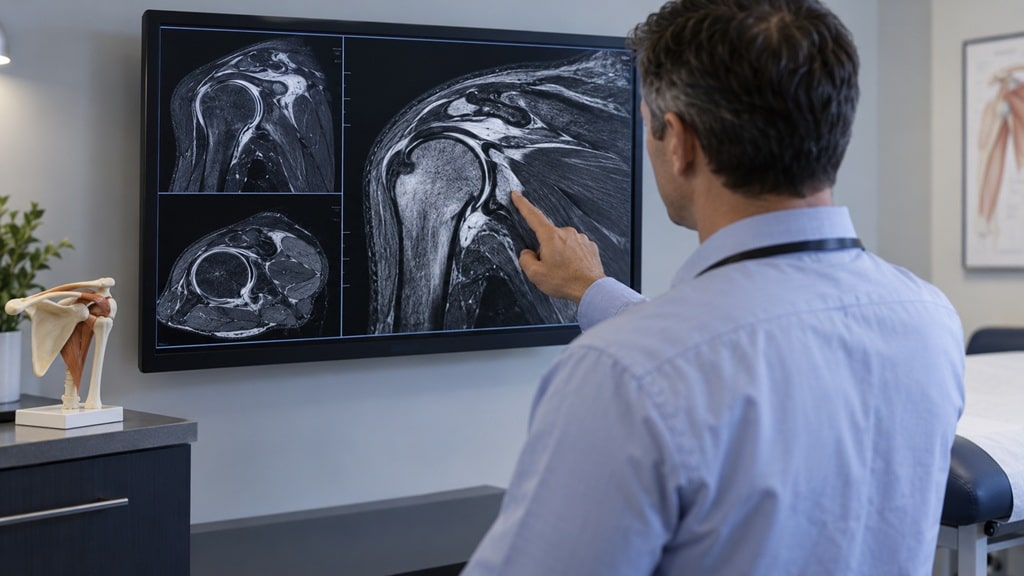
Reading the MRI images, not the report
A radiologist’s report is a summary. It is written without your history, without your physical exam, and without knowledge of what treatment is being considered.
Whether a partial-thickness tear is a reasonable candidate for a biologic depends on where it sits, how deep it goes, how retracted it is, and the condition of the surrounding tendon. A surgeon who repairs these tendons reads those images with that context in mind.
I review the actual images for every patient before recommending anything. If you have a study from elsewhere, bring it on disc or arrange electronic release rather than bringing only the written report.
Patient Takeaway: Ask whether the person recommending the injection will look at your MRI images, not just the radiology report.
Real-time ultrasound guidance
Published accuracy studies consistently find that unguided shoulder injections miss their intended target a meaningful percentage of the time, with the widest misses in narrow spaces like the subacromial bursa and the biceps tendon sheath.
Ultrasound guidance requires equipment, training, and regular practice. I perform every PRP injection under live ultrasound, watching the needle tip on screen as it reaches the structure identified on your imaging.
It is worth asking any provider whether the needle will be visualized in real time, and who will be holding the probe.
Why the shoulder specifically demands this
The shoulder has the greatest range of motion of any joint in the body, and it achieves that with a tightly packed structural design. The subacromial bursa and the biceps tendon sheath are millimeters across and sit directly beside structures you do not want to inject. A partial-thickness supraspinatus tear may be only two or three millimeters wide.
These are not forgiving targets. That is the entire reason I teach this technique rather than assuming it is intuitive.
What happens when PRP is not the answer
This is the difference that matters most, and it is the hardest to see in advance.
Some shoulders should not receive a biologic injection. A massive retracted rotator cuff tear will not be resolved by one. Bone-on-bone glenohumeral arthritis will not either. In those cases the right conversation is about surgical repair or replacement, and an injection is a delay that costs money and sometimes costs time that matters for the outcome of the repair.
When I examine a shoulder, PRP is one of several things I can offer and surgery is another. That does not make me neutral — I have my own incentives — but it does mean I can tell you an injection is the wrong idea without sending you elsewhere to find out.
A practice that only performs injections can refer you out, and many do. It is simply worth knowing in advance which kind of practice you are in.
What to ask any practice offering shoulder PRP
These apply to my office as much as anywhere else:
- Who performs the injection, and what is their training in shoulder conditions?
- How many shoulder injections have they performed?
- Will you review my MRI images before recommending treatment?
- Is the injection performed under real-time ultrasound guidance?
- What is the total cost, and is a series being recommended up front?
- What happens if PRP is not appropriate for my injury?
- If it does not work, what is the next step here?
Any practice should be able to answer all seven without hesitation.
Schedule an evaluation
You do not need an MRI, a diagnosis, or a referral to be seen. If your shoulder hurts and you want to know why, that is enough.
I will examine your shoulder, review any imaging you have, and tell you what I see — whether that points toward PRP, physical therapy, an injection, or a repair.
Call (619) 462-3131 or request an evaluation. Our office is in La Mesa, and we see patients from across San Diego County.
You may also want to read our full guide to PRP injections for shoulder pain, our comparison of PRP and stem cell therapy, or more on why ultrasound guidance matters.

This article is intended for general educational and informational purposes only and should not be considered medical advice. Reading this content does not create a physician-patient relationship. Always consult a qualified healthcare professional regarding your specific medical concerns, diagnosis, or treatment options.